Friday, April 06, 2007

A New Keys Bonefish Record?...


Huge Bonefish Caught in Florida Keys Weighs in at 16 Pounds, 3 Ounces; World Record Pending
Wednesday, 04 April 2007
For Immediate Release

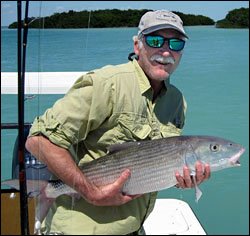
ISLAMORADA, Florida Keys - A Connecticut school administrator caught and released a monster bonefish in the Florida Keys last week. It may be the heaviest certified bonefish ever caught on rod and reel in the Western Hemisphere.

Bob Schroeder's 16-pound, 3-ounce bonefish was brought in alive and weighed on an International Game Fish Association-certified scale at The Worldwide Sportsman dock in Islamorada March 19 and then released.

Samples of the mono leader and 10-pound Power Pro braided line were sent to the IGFA along with required documentation to determine if the catch qualifies for a world record in 12- or 16-pound-test line categories. Approval or denial of the record is expected by mid-May or earlier, according to Rebecca Reynolds, the IGFA's world record administrator.

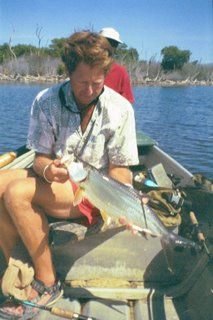
Bob Schroeder shows off a 16-pound, 3-ounce bonefish he caught, weighed and subsequently released alive off Islamorada in the Florida Keys on March 19, 2007. The fish is pending world record certification and maybe the heaviest certified bonefish ever caught on a rod and reel in the Western Hemisphere. (Photo by Paul DiMaura via the Florida Keys News Bureau)

The existing IGFA record for 12-pound-test line is a 16-pound bonefish caught in Bimini in 1971 by Jerry Lavenstein. Islamorada guide Tim Borski holds the current 16-pound-test line class record with a 14.25-pound bonefish he caught off Islamorada in 2002.

If certified, Schroeder's bonefish will be the third largest on record at the IGFA. The two larger bonefish - a 19-pound fish caught in 1962 and a 17-pound fish caught in 1976 - were caught in South Africa.

Schroeder and Captain Paul DiMaura of Islamorada and Martha's Vineyard, Mass., had planned on fishing for redfish, but the wind was so brisk they decided to try bonefishing on Islamorada's flats. The pair fishes together often, almost always casting flies.

"It was blowing so hard we put the (fly]) rods down," said Schroeder. "Paul saw the fish about 100 yards away and stopped the boat. The wind was at our backs and probably if the adrenalin hadn't kicked in we might have picked up the fly rods."

Still, Schroeder had to make an accurate long-distance cast with a live shrimp in a gusty wind.
"It turned out to be one of those classic perfect shots," he said. "The shrimp landed far enough in front of the fish not to spook it. It came by and ate the shrimp."

"The fish pulled most of the line - more than 200 yards - off Schroeder's spinning reel while DiMaura "poled like crazy," said Schroeder.

"When it got to the boat and we could see the shoulders on this thing, I got more instructions than the space shuttle," laughed Schroeder.

DiMaura was humbled by the catch. He has fished the Islamorada flats since the 1960s and was a professional guide during the 1980s. He still maintains his captain's license in the Keys.
"It could have happened to anybody and it happened to us, and I appreciate that," said DiMaura. "It was being in the right time and the right place."

DiMaura was also proud of the series of photos he took while Schroeder released the bonefish. After very careful handling, the fish swam away.

"Happily, the fish is still out there," said DiMaura.

Website: http://www.fla-keys.com/

Sunday, April 01, 2007

Caribbean Odyssey...


Caribbean Odyssey
(As seen in November/December 2006 Issue of Florida Sport Fishing Magazine)
by

Jan Stephen Maizler

Photography
by
Jan Stephen Maizler


Entry to a new angling destination often involves anticipation and adventure. Yet, when a sense of magic enters the mix, the experience becomes especially memorable. Little Cayman Island’s Southern Cross Club embodies all these qualities and more.

I’d taken a quick two-leg flight on Cayman Airways from Miami to Grand Cayman to Little Cayman. Upon arrival at the island’s compact airport, I was whisked away by van to the Club-mere minutes away.

My midday arrival was on May fifth and I was informed by the Club’s friendly intake staff that a double soiree would be underway later that day: the Club was having a traditional ”Cinco De Mayo” celebration. The prospect of a Latin bash would be fun, but platformed on top of that was a concurrent party celebrating the eleventh anniversary of owner Peter Hillenbrand’s purchase of Southern Cross Club. Come sunset along this resort’s beach and pier, feasting, festivities, and fireworks would begin.

This would leave an afternoon free for some creative angling and exploring on my own. As I gazed around at the sugar-white beach, sunny bungalows, and blue sea, I felt my stay at this resort was going to be a great experience. The good choices that create great experiences often rest on thorough research, something traveling anglers should always keep in mind.

Although many anglers are familiar with Grand Cayman Island with its posh resorts and striking beaches, fewer are familiar with its sister islands of Little Cayman and Cayman Brac. Both of these latter islands lay south of Cuba in line with Miami along the famed Cayman Trench and its fish-filled waters. Though these islands are known to offer world-class diving and snorkeling, they offer fine fishing as well. Little Cayman has the smallest population of the Cayman Islands and the real possibility of the least fishing pressure. In addition, Little Cayman has a unique combination of island-ringing sand flats, reef flats, and an inland lake that offers fine chances for a flats grand slam.

The proximity of the Cayman Trench’s deep drop right outside of the barrier reef makes blue water fishing a ten-minutes-from-port proposition. All of these marvelous features are topped off with peaceful and safe social conditions that make unlocked doors the norm. This made Little Cayman and Southern Cross Club my odds-on choice to visit one of the most well rounded islands in the entire Caribbean!

I decided I’d spend the afternoon exploring and fishing around Owens Island, which was alluringly situated perhaps a mile offshore of Southern Cross Club. I took one of the Club’s complementary kayaks and loaded it with three bottles of water, a fly rod, a spinner, and a small box of terminal tackle. I eased the vessel off the beach into the clear water, got it to a floatable depth and climbed in. The flats began right off the beach and were topped with a lush turtle grass carpet. Later, the shallows would transition to sugar-white flats surrounding the island.

I did see a few bonefish on that paddling expedition, but “’yakking and jacking” came closer to describing the fishing as I reeled in countless bar jacks and yellow jacks. Leading these fast moving fish a good distance with a rapidly retrieved jig or fly was the recipe for success. In what seemed like an hour, four hours had passed and it was time to paddle back to the Club: the afternoon was nearing an end.

As dusk arrived, the yellow and white tones of the beach transitioned to a soft orange. As I watched from my porch, a slow trickle of people headed towards the Club’s dive boat pier where the party was starting to take shape. As the sun dropped notch by notch over Little Cayman, the more the moving figures became silhouettes.

The growing laughter and enticing aromas of a festive Mexican buffet lured me up to the pier as well. As I waited for a rum and coke at the thatched pier bar, my peripheral vision picked up what seemed to be two tails that popped up out of the flats not thirty feet away. Somewhat amazed, I rescanned the area with my Double Bird Dog Power Gaze. Sure enough, the tails were still there…and they were long, blackish, and scepter-like.

A voice from behind me said, “ yeah, they’re permit and they tail right along this beach every dusk when conditions are right.” That’s how I met Buck Buchenroth, who was to be my fishing guide for the next three days.

The evening became a merry-go-round of angling dreams and personal sensations: talks with Buck about early tuna bites, getting a flats grand slam, spicy enchiladas, frijoles, and tamales, and overhead, multi-colored astral bursts of fireworks that would light up the Little Cayman sky and give way to the purple star-studded dome above us. It was a night to remember.

FISHING DAY #1- An Introduction To The Deep And The Flats-

Five-thirty a.m. came quickly. I could hear Buck firing up the engine on his twenty-five foot center console. Since he’d made it clear that the tuna “bite” was early and short, I dashed from my front door to his boat, a distance of only one hundred feet. When I hopped aboard, all the rods and rigs were in place. In moments, we cast off. The run to the blue water would be quite short: a quick shot from the dock through a break in the barrier reef and into the deep blue water took only ten minutes.

As soon as we were riding sapphire seas, he pointed to some wheeling gulls and diving frigate birds two hundred yards away. “ There’s our tuna “, he said. As we reached the halfway mark to the action, Buck let out blue plastic squids rigged below large drail sinkers on fifty-pound conventional tackle. He instructed me to troll these baits well astern at least fifty yards. Within moments, there were strikes on both rods. Double hookups were the norm until the action slowed down about twenty blackfin tuna later. As the low light action abated, I could feel the warmth of the early morning sun on my shoulder. Buck said, “ that’s it for now.” He gunned the throttles and we were back at the dock at 7:15 a.m. for an early breakfast of fresh fruit, yogurt, eggs benedict, and plenty of hot coffee.

Our next plans were to meet after breakfast and a short rest about two hours later and wade-fish the flats that lace the island. The method was to truck over the roads and stop at the roadside to park and walk through the many secret trails that Buck had cut through the scrub to the breathtaking beaches. Our target fish were bonefish, permit, and large barracuda cruising the sand and rubble flats. After a few hours of ocean flat hunting, Buck wanted me to sample and experience Little Cayman’s famous landlocked lake for tarpon.

Exactly two hours later, Buck’s pickup appeared through my bungalow window: I was to learn that Buck’s exactitude was one of the characteristics that made him one of the best guides around. I brought two nine and one-half foot, eight-pound test spinners rigged with shrimp I’d taken from Miami. Buck brought a heavy spinner rigged with wire-leadered tuna belly strips from the earlier trip. In the next few hours, I caught one bonefish, two barracuda of fifteen and twenty pounds, six bar jacks, and five yellow jacks. I also lost two more bonefish to some rocky points despite the length of my rods.

Buck then drove us to the inland tarpon lake where Southern Cross Club keeps its own aluminum rowboat. As we walked on the pier through the primitive mangrove jungle and mud flats below, I thought I was in Jurassic Park. As we eased into the boat, there were fish rolling everywhere around us. I switched my bait to a one-eighth ounce yellow/orange Spro baby bucktail and a twelve-inch piece of twenty-pound fluorocarbon leader. My results for that excursion were three fish jumped and three fish averaging ten pounds leadered and released.

Although Buck said that marked the end of our fishing for the day, he advised me to walk the beach at dusk slightly west of the club and look for bonefish tailing right in the surf’s edge. I followed his instructions and caught two more bonefish that evening less than one hundred yards from my bungalow.

Fishing Day #2- Grand Slam Day-

Easterly winds of 10 knots and a 9 a.m. high tide created a perfect permit morning for our second day of guided fishing. Within ten minutes of leaving the Club with Buck’s pickup truck, we were walking through some sea grape scrub onto a long beach flat comprised of sandy strips with multiple grass patches.

We saw some disturbed water headed our way and I lined myself up with what I hoped was a good intercept point to make my presentation. As the fish got closer, a bunch of black sickle tails popped through the wind-burnished surface- they were permit! When the fish got within casting range, they slowed and milled around the bottom. Since they were in a meandering pattern, it took three ultra quiet casts to hook up. Within minutes, I’d released a permit…small, but still a permit.

At that point, Buck insisted that we leave the flats and head for the tarpon lake. He said I could be sure this was to be a grand slam day. We arrived at the lake, where there were less rolling fish than the day before. In addition, the baby silver kings seemed slower to strike. In the ensuing hour, there was only one soft bump. Then we both saw a tarpon strike aggressively at a minnow near a tree stump. Within seconds, my bucktail landed in the remaining boil and I had an immediate strike. Ten minutes later, we released a fifteen-pound tarpon at the side of the boat. That made two of the three species I needed.

Buck and I met up four hours later at the low tide. We took his whaler style-skiff across the Sound and found a large school of mudding bonefish. In two minutes, I completed my Grand Slam. I released 6 more bonefish for good measure, and we called it quits with high-fives and big smiles.


Fishing Day #3- A Day of Inshore Diversity-

On our last day, we spent the day poling the Sound in Buck’s flats boat. We started the day with catching and releasing a seven-pound tailing bonefish. As we poled the mud flats and sugar-sand flats we tallied another ten bonefish releases, three large yellow jacks, one large boxfish that we ate later, and a bunch of mutton snapper.

We topped off the afternoon snorkeling the beautiful reefs off Little Cayman’s west side. The blue clarity of the water was so striking that the only place you’d swear you could find that color was in a dream. A bit later, we caught a few yellow-green and blue queen triggerfish, simply to enjoy their beauty close at hand and release them.


THE DESTINATION

In retrospect, I cannot recall a Caribbean fish and dive resort with such a diversity of gamefish. Southern Cross Club is a safe, stable, well-appointed destination that is so easy for traveling anglers to reach. The Club has a venerable history of habitat management by rotating all of its fishing areas.

The facility itself has approximately ten oceanfront bungalows with breathtaking views. Each unit is decorated in tasteful Caribbean motifs in air-conditioned comfort. Their meals are absolutely outstanding. One day, lunch consisted of pepper-dusted boxfish chunks, smoked turkey and Swiss cheese on just-baked baguettes, fresh French fries, lobster bisque, and topped off with chocolate cake with coffee or tea.

Amenities include complementary bicycles and kayaks for land and sea exploration. The beachcombing potential, exquisite reefs, and huge bird colonies make this an island paradise for do-it-yourselfers. The Club has two excellent and uncrowded dive and snorkel boats- ideal for anglers that enjoy this as well as non-angling family or friends. For a taste of the relaxed island beat, snooze in the shade of a palm tree, wade the crystal clear lagoon, have a float in the freshwater pool, or walk the beach under star-studded sky.

Southern Cross Club has an extremely high staff to guest ratio. This gives rise to a level of service quality that keeps guests returning again and again. If you want to bring children, you’ll be pleased to know that the Club has designated family dates- just contact them for these exact times. All of these marvelous features make Southern Cross Club a must-visit destination for first-time or seasoned traveling anglers alike.


WHEN YOU GO:

Many different carriers fly to the Cayman Islands. I personally was extremely pleased with Cayman Airways, but your research will turn up multiple and satisfactory alternatives.


CONTACT DATA:

Southern Cross Club
P.O.Box 44
Little Cayman Island
Cayman Islands, BWI
Website: http://www.southerncrossclub.com/
Email: scc@candw.ky
Telephone: 1-345-948-1099
Fax: 1-345-948-1098

Reservations:
Craig Buck, Southern Cross Club
Email: socrossclub@cox.net
Telephone: 1-800-899-2582

Captain Buck Buchenroth can be reached through the above contact data.

A Casa Blanca Adventure

Welcome to Mayan Land

(As seen in January/February 2007 Issue of Florida Sport Fishing Magazine)

By Jan Stephen Maizler


It was deep in the middle of a star-studded night. The only sounds that could be heard were the collective whooshing rattles of coconut palm leaves pulsated by the Caribbean sea breeze. I made my way through dunes and valleys of sugar sand towards the grass-thatched ocean pier- its spotlight cast a yellow luminous orb over the greenish rolling wavelets.

As I walked along the pier’s concrete approach towards the well-lit pot-o’-gold at the tip, I was filled with the anticipation of a nighttime game fish encounter. The metallic clicks of the fly, spinning, and baitcasting outfits I was carrying played second fiddle to my heartbeats and sculpted stride in this orchestra of excitement.

As I neared the edge of the lit water, I made my movements slow and subtle-no different than the reverent sneak of a trout angler on the cusp of his stream. As I gently put down the three outfits, I gazed into my target area. And what I saw screamed, “Yes, yes, yes!”


I was witnessing a nighttime game fish grouping that was a “first” in my angling career: the expanse I was about to cast into was a fishbowl of tarpon and permit! The silver kings-seemingly everywhere- were on the move from top to bottom. They’d glide through the light, roll over the waves, and then suddenly strike at a pilchard with a lunging flash. In contrast, the permit finned patiently on the surface as they faced into the incoming tide. Suddenly, one of the larger fish out of perhaps twenty struck into a clump of seaweed. Two crabs were dislodged, but it seemed that their usual rapid sideways retreat was prevented by their disorientation. In barely three seconds, the permit engulfed them.
I breathed deeply to quell my excitement. Slowly, I leaned over and picked up my plug rod. It was loaded with 12-pound test mono and topped off with a 40-pound fluorocarbon leader and a one eighth ounce yellow-orange Spro baby bucktail. I felt that the lure would match the hatch, and the outfit itself had the beef to fight some gamesters I was seeing that weighed up to around forty pounds.

After testing the drag and free spool tension, I flicked off a cast in front of and slightly past the group of permit. I began my retrieve immediately and swam the lure slowly across the surface in front of the lead fish. Before the lure could reach its intended target, a tarpon rocketed into the lure with a vicious strike. I struck the fish hard and it went airborne, sending frothy water in all directions- I could see permit start scattering from this sudden melee. I dropped my rod tip to bow to the leaping silver king, but its vicious headshakes threw the lure.
As I reeled the lure close to the rod tip, I saw the group of permit hovering at the edge of the lit-up water. I flipped another well- placed cast at the school and began my retrieve. As my bucktail came even with the permit, a smaller fish of about ten pounds peeled off from the group and inhaled the Spro bucktail. I struck the fish and could see its head shake violently as the hook dug in. The fish began a long run of about fifty yards and slowed down. Under the pressure of the plug outfit, the permit made two shorter runs and then slowly surrendered. I eased the fish towards the pier until it was beneath me. I had to lie down on the wood to reach Sir Quicksilver for an effective release. After removing the lure, I breathed the fish for about a minute. After it seemed to regain its stamina, I let go of its tail. It swam slowly through the light into the safe obscurity of the darker water.

After this victorious battle, my magic fishbowl was a quieter place. I sat down under the thatched roof on the circular concrete bench to give the area a ten-minute rest. The fish did return and I succeeded in jumping two more tarpon in the next half-hour.

I slowly concluded it was time to quit fishing. I felt satisfied for many reasons. I stood in the midst of this starry sultry tropical solitude and relished the realization that I was on the beach of an exotic Mayan island offshore of Mexico at the five-star Casa Blanca Lodge. But the best part of this experience was knowing that the action I had took place on the night of my arrival day and that the actual guided fishing would not begin until tomorrow!

Great Beginnings-

As my trip to Casa Blanca and its sister lodge Playa Blanca began to take shape, the efficiency of their operation quickly manifested itself. The first part of this process was query contact with Lily Ann Prevost, the Office Manager of Outdoor Travel, Inc. in Harlingen, Texas. She sent me brochures, DVD’s, and their specially published Travel and Outfitting Guide. After reviewing these items, all questions were answered and it was simple to set up the travel times and itinerary.

Casa Blanca lies on an exquisite coastal island at the southern edge of Ascension Bay. On this same pristine land twenty miles to the south, Playa Blanca Lodge sits perched on the northern fringes of fish-filled Espiritu Santo Bay. All of this magnificence is on the Quintana Roo/Caribbean coast of the Yucatan peninsula approximately 100 miles south of Cancun. These wonderful facilities are blessedly in the midst of the Sian Ka’an Biosphere Reserve, which guarantees the future preservation of this remote habitat as well as its prolific numbers of fish, birds, and animals. The Mayan name, Sian Ka’an, means “birthplace of the sky”- this gives an idea of the reverent tribute these people gave to this region.

A large part of the pre-travel excitement was the knowledge that I’d be heading to a destination that featured dense jungle, shallow bays, secluded lagoons, rocky beaches, and sugar sand beaches that fronted the exquisite sapphire and emerald-colored Caribbean Sea. I was also eager to encounter the hummingbirds, frigate birds, pelicans, caimans, foxes, dolphin, turtles and most importantly, the bonefish, tarpon, and permit that abounded there.


Fishing in Paradise-

The guide that was assigned to my photographer, Art Blank, and myself was Agustin. He was very experienced and very exacting. I found it reassuring that he had over 15 years experience guiding in this expansive bay. His fishing rig was a 16-foot Dolphin Super Skiff powered by a four-stroke 50 H.P. electro start Yamaha with tiller handle steering. His skiff easily handled the tackle and equipment we loaded into it and floated in only six inches of water.

Before we got underway, I was sure to let Agustin know the exact fishing goals for our stay- not surprisingly, it was to sample as much variety of light tackle fishing the area offered. Since it was November, we understood that the possibility of changing weather would also affect our choices. It did indeed transpire that over the next five days, the weather went from calm to windy and sunny to cloudy, but the diversity of the habitat always provided us with a productive fishing spot.


The first day started windy and we only had to snake through the mangroves for sixty seconds before giving fishing a try. On our way through the creek, we spotted a large caiman sunning itself and a huge tailing bonefish. We then entered into the spacious Laguna Pajaros and the skiff immediately slowed down. The guide pointed to a large mud one hundred yards downwind. As we eased over, we pulled out ultralight spinning gear armed with tiny white Spro bucktails tipped with shrimp. In another minute, we had our first double header Casa Blanca bones next to the boat.

We enjoyed this action for a while and then asked for shallower action further afield. Agustin ran his skiff through some creeks and into the open bay. We ran for about ten miles to a series of shallow yellow and green flats. Agustin cut the engine, lifted it, and began poling. Throughout the day, we spotted bones every few minutes. However, the high winds and a bit of gray ghost skittishness that I attributed to a shifting barometer limited our results from fantastic to excellent. It would turn out that day #2 would be a gratifying repeat of the prior day.

We woke up to day #3, which featured light north winds and china blue skies. Agustin felt this was a perfect day to run to the blue holes to the north of Casa Blanca. He told us that we’d have to hunt up some live crabs. We pulled up to a sandy beach and began a bait-catching adventure that was fun in its own right. After we’d put a dozen into the bucket, we climbed back into the skiff and only ran for 15 minutes before slowing down. Agustin eased the skiff upwind of the hole and cut the engine. We drifted for a few minutes until we were within 70 feet and Agustin quietly lowered his anchor. We did not need him to point out that there were fish everywhere. Balao were flipping all around the boat while every minute a large mackeral would skyrocket through the bait. Then we saw large tarpon rolling. Urging us to be quiet, Agustin baited us up with small live crabs. In about 60 seconds, he said, “2 0’clock and 50 feet out…permit!” Art and I saw the fish and cast. In a picture perfect repeat of the first mornings’ casts, we had a double-header hookup but now with large silvery permit.

After arduous battles, we landed both fish, each of which was about 20 pounds. While there seemed to be no more obvious permit, there were loads of game fish. I pulled out my plug rod and jigged the area with a white bucktail tipped with shrimp. I ‘ll have to admit I lost count of the mutton snappers, cero mackeral, lane snappers, blue runners, and barracuda that I caught. The sun set as two sated and satisfied anglers headed home.

Day #4 was taken up with Agustin running us to Playa Blanca via the ocean for our visit to the sister lodge. The bulk of the day was taken up with touring and trekking around this destination- a wonderful experience. We had a couple of hours left upon our return to Casa Blanca. Art opted to go with Agustin to pole the ocean flats for permit, while I chose some solitary wading for bonefish around the lodge. As their skiff disappeared to the north, I found a nice school of bones. Since I was using ultralight spinning, I was able to cast a weighted fly into their midst with the tiniest plop- the hookup was immediate. After landing a nice 4- pound bone, I repeated this conquest 30 minutes later. When Art returned, he said they saw permit, but a tree stump the fish were swimming around prevented a good presentation.

Our last day featured perfect weather. We ran to the blue hole immediately and Art caught a nice permit. While the prospects were enticing, we opted to finish the day on the flats. Agustin zipped us into a lagoon and within 30 minutes was poling us towards a large tailing permit. When the moment of truth arrived, I made a perfect cast. The line came tight and I struck. About an hour later, we were posing and releasing a 25-pound permit. Agustin then poled us towards the mangroves featuring water less than a foot deep. We topped off the day with three more bonefish. The fishing had been marvelous!


The Operations-

The managing owner/partner of these two lodges -Casa Blanca and Playa Blanca- is Mr. Bobby Settles. Ho told me that the mission of both operations is to “provide comfortable accommodations, superior food and services, and quality fishing in a sustainable habitat that produces great action year after year.” After sampling both of these wonderful destinations, it’s clear that he has created two destinations that operate with “Swiss watch” efficiency in the midst of a Mayan wonderland.

Casa Blanca-

Casa Blanca is the lodge that features the most structured dedicated fishing program. The facility is set along a stunning rocky beach point that contours into a protected sand beach where its 11 flats skiffs are moored. This venerable destination quickly stabilized any outlaw netting in the Biosphere by employing the locals and integrating them into their hotel and fishing operations.

Casa Blanca lies only five minutes by boat from their private landing strip. This lodge has a long sturdy pier that has multiple functions. It serves as the boat-based staging area for arriving and departing guests. This structure is also the landing point where both lodges receive their supplies and fuel brought in by large reliable pangas on a regular basis. The pier also doubles as a nighttime fishing hotspot for certain unnamed angling fanatics that can’t get enough fishing. Well-appointed and strong trucks transport guests and supplies to Playa Blanca which is about one-half hour to the south. Tom Hamilton is the manager in charge of the fishing, the boats, and all the logistics functions. He made it clear that his purpose was to make sure that all guests were pleased and happy.

I was impressed that the configuration of buildings at Casa Blanca mirrored their purposes so well. There are eleven rooms-all of them air conditioned- that are set conveniently close to the pier, boats, dining room, and the relaxing centralized palapa and patio. Maria is the manager in charge of hotel operations that govern all the services and amenities for traveling anglers. She emphasized that “no item or desire was too small...we want our anglers satisfied.”

The staff scores 100 per cent in how you’re treated. This begins with a delicious ice-cold margarita that is served to you as you board their pier from your transport panga. It continues with delicious breakfasts of local fresh fruit and dishes of your choice through dinners of fish, chicken, steak and lobster all the way to after dinner cigars and perhaps a massage to top off a day of great fishing under the shining tropical sun.

Playa Blanca-

This wonderful facility also features a dedicated fishing program with 6 flats boats situated at the nearby Laguna Santa Rosa dock. This lodge has achieved its own beauty, which is desirably and distinctively different than its sister to the north. This facility has a beautifully spacious layout that features 7 rooms and the elite stand-alone Casa Redonda, 400 meters to the north. The entire property is bounded by a sugar sand beach lapped by the Caribbean Sea to the east and the primordially stunning Choc Mool Mayan ruins to the west.

Playa Blanca has unique appeal to anglers traveling with non-angling friends or spouses. The bountiful offerings of kayaks, snorkeling, eco-trekking, exploring the ruins, or simply relaxing makes each day at this destination a pleasurable adventure. When you arrive, you’ll be pleased to meet the delightful team of Max and Clara. Like their counterparts to the north, he handles fishing, fleet, and logistics while she handles hotel operations.


WHEN YOU GO:
You fly from your American city to Cancun. Guests making their own flight reservations must plan to arrive in Cancun no later than 2:00 p.m. and schedule their return flight from Cancun no earlier than 11 a.m. The lodge provides the transfer flights, which offer spectacular views and take less than an hour.

CONTACT DATA:
Casa Blanca Lodge
Telephone: 1-800-533-7299, 1-956-428-5666
Website: www.casablancafishing.com/
Email: outdoortravelinc@rgv.rr.com

Sunday, March 25, 2007

Watching and Waiting....


The last two Fridays have not been easy weather days. The first one was shattered by electric storms and squalls that had most bonefish skiffs trailered and on their way back up I-95 by mid-morning.

Yesterday, Friday number 2, was still blowing almost twenty miles an hour after four previous days where the onshore winds were gusting to thirty miles per hour. There was plenty of sunshine emerging, but the early low tide, slow current, and gusty winds were not favorable for the tarpon that I started scouting for on the open water shallow flats. I could have skipped back to the inland brackish rivers to stay after the fish I knew were still present, but the novelty was dying off with three prior successful trips.

Although it is obvious bonefishing is not WHAT or WHERE it used to be, the last few years have seemed to feature a good push of fish around Good Friday season. Generally, by that time the sun has gotten the water temperatures up enough and the cold fronts are more a wind experience than anything else. Whatever the case, I'll be watching and waiting....


Jan

Sunday, March 11, 2007

Back in the Seventies...

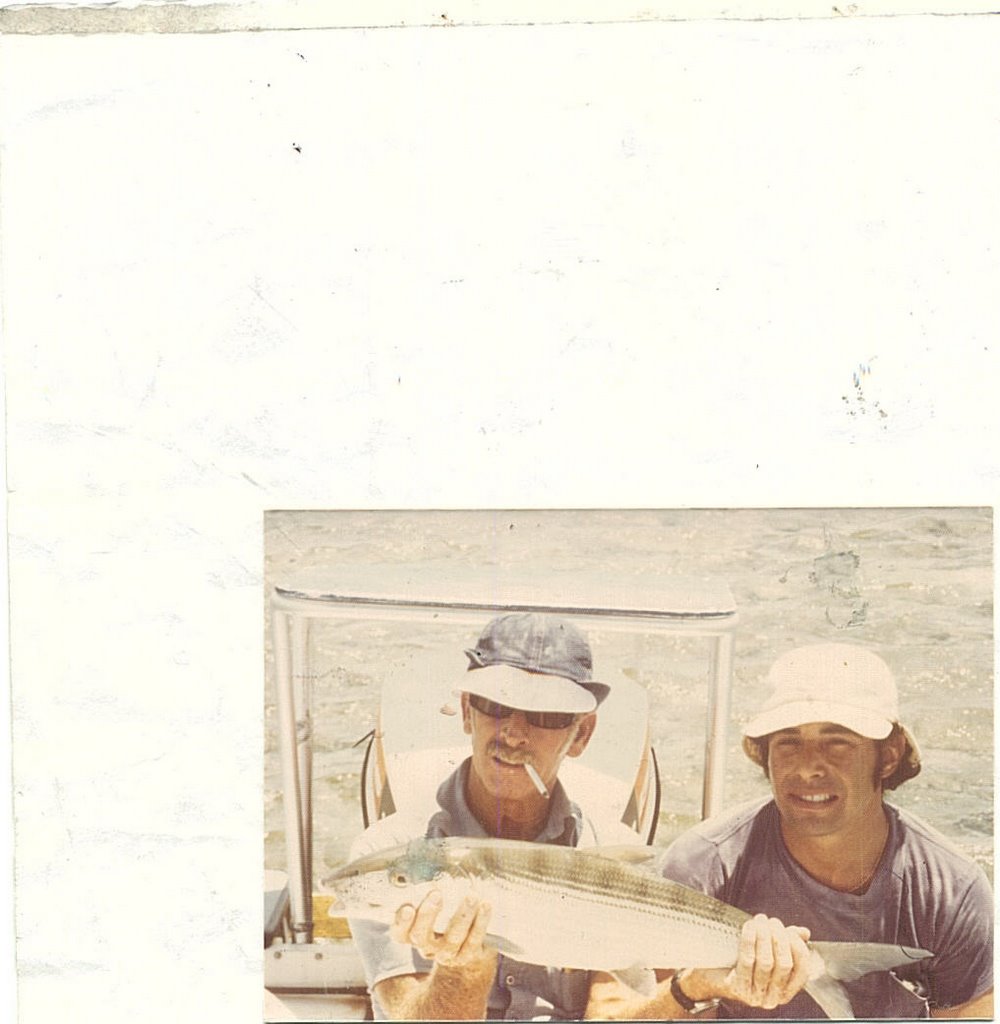
I happened upon this little treasure of a snapshot as a half-hidden artifact lodged in the roller track of a dusty photo drawer. It was faded, scratched andd gummy, yet I felt that I'd unearthed the Star of India.

Like an old song gone unheard for a long, long time, it unleashed a torrent of feelings, ideas, and companion images (each with their own qualities)- kind of like diving into an exponential recollection vortex.

I sat gazing at this image of Bill Curtis and I that was recorded in the summer of 1973. Most importantly, I remembered so much of that day, that year, and that era. It was a time when the flats boats in Biscayne Bay could be counted on one hand. No doubt, many of the light tackle personalities that grace the TV screens of the new millenium were children or adolesents playing ball in driveways or chasing grasshoppers for bait along a stream in some western state.

The angler in me was most interested in relishing the exact details and circumstances of this trophy bonefish that made us one hell of a trio. My historical muse got first dibs and would certainly relent, but not before noting our sideburns as well as the cigarette(s), the latter of which no longer belongs in our lives.

The memories unfolded... that day was one of the bright types of early summer experiences that featured loads of sun but the gusty northeast winds that high pressure off the Carolinas would bestow upon Florida. Although the water temperatures and overhead light were fine, the bonefish seemed scarce- until we got to the Featherbeds. As soon as Bill poled onto the southeast corner of that huge crescent, we saw bonefish cruising, mudding, and following rays. It felt downright delicious having the luxury pondering which of the fish we'd pursue.

Since I was never one for patience, I asked Bill to go for the fish following a ray only fifty feet
away from us in the twelve o' clock position. He pushed hard into the wind and in short order my shrimp landed between the ray's tail and three feet in front of the bonefish. I feathered the landing to minimize the plop and it quickly eased to the bottom in seconds. The fish gobbled it like there was no tomorrow. The first run almost spooled me, but Bill poled furiously in pursuit. I slowly regained line and my concerns eased a bit. Two more runs and ten minutes later, the fish was brought alongside the skiff, lifted aboard, and posed by two happy adventurers to create an image that would be rediscovered with such delight by a much older man far in the future.

I do recall that after we released that big boy, Bill mentioned there was a stretch of flat a hundred yards ahead that would likely have some permit casually cruising the edges in all this wind. I remember saying, " let's go for it." But that's another story, and I do have all those requisite snapshots... right here in my heart and my mind.

Jan
www.flatsfishingonline.com

Friday, March 09, 2007

Big Tarpon Time ! ...


Springtime has definitely come to SOFLA and the tarpon push is on. The water in north and south Biscayne Bay has edged into the seventies- at least for now. March in Miami does feature cold fronts, but they are more of wind event versus a temperature-dropping event.

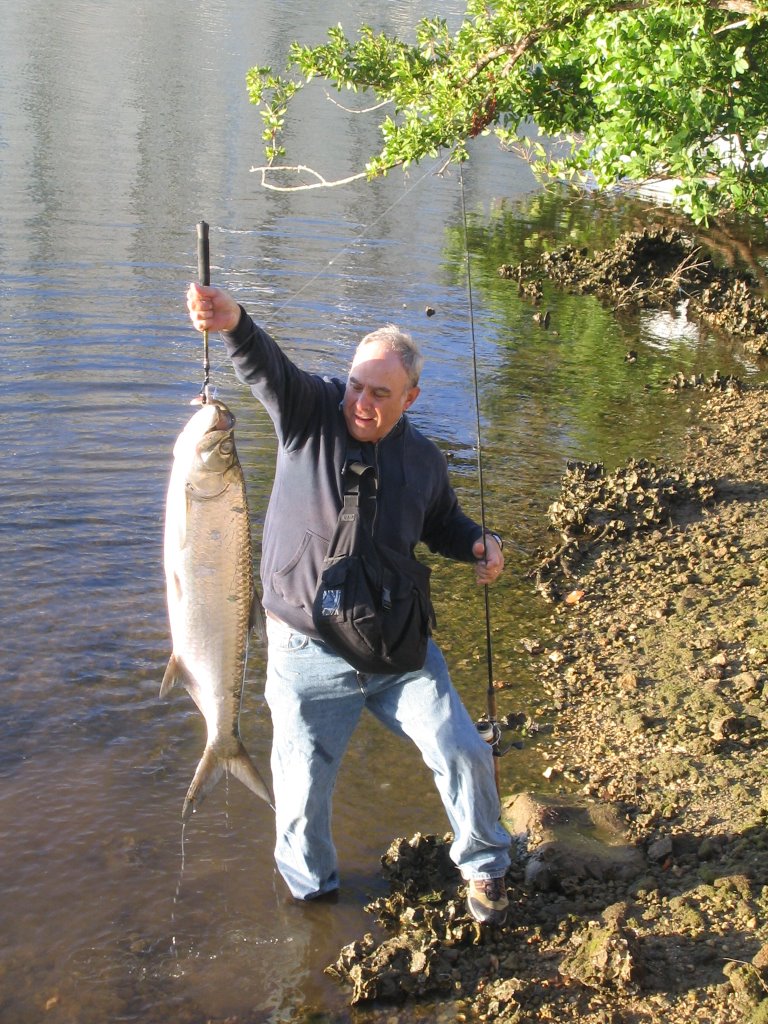
One of the reasons my stories and reports have waned during the last few weeks is in fact, my near-rabid pursuit of the silver kings. I've been fortunate enough to have landed three fish from 80 to 120 pounds in as many weeks. They were caught on either 10 or 12-pound class tackle. The baits for these gamesters were determined by how and where they were feeding- a white bucktail tipped with shrimp, a live shrimp, or in the case above, strips of kingfish bellies.

As to the possibly indiscrete and unfashionable nature of my hero pose, some comments are in order. It would have been hard to pose the fish in the water unless I grew 12-foot legs. In addition, the most recently-recommended guidelines of the horizontal double-handed under-gripped pose is often a mistake. Anyone who has tried this on a big tarpon ought to admit that a ton of protective slime was lost as well as the possibility of some scales as well. Maybe the fish was even dropped on the deck. Big tarpon simply cannot be posed like the small fish of the Yucatan peninsula. As for the concerns of the viscera-displacing damage of the vertical pose, I seriously doubt a three second event could accomplish this. This tarpon shot off like an oiled banshee when I released it. I never touch any gills, but get a grip AROUND the cheek and throat tissue; and the remaining two fingers are placed under the gill plate. I brace my wrist, as 80 pounds is a big load for that thin connection between hand and arm. I noticed that this tarpon seemed far more well-constructed than people.

Some words are in order about tarpon size and the angler's experience. If you are told small tarpon up to twenty pounds do the same things as big tarpon, you'd better reconsider that remark thoroughly. Fighting a big tarpon is an epic experience that is totally different than battling a small fish. You often wind up releasing your fish very far away from where you hooked it. The 100-pounder I released today was hooked off the north Coconut Grove and released 1 mile south of downtown Miami- this battle was spread over two miles! This fish was caught on 12-pound tackle. If the same tackle were employed catching a 15-pound tarpon in a creek on Tamiami Trail, Grand Cayman, or Chetumal Bay, it's likely the angler would not even have to move, much less the skiff- if there was one! Going to 6 or 8-pound class tackle (whether it's fly, plug. or spin) spices up the battle. Nevertheless, battling a 100-pound tarpon is not the same experience as catching the same species weighing 10 or 15 pounds.

Jan

Tuesday, February 27, 2007

Deadman's Cay Memories....


It's good to savor last summer's images of Deadman's Cay. Like a cup of hot cocoa by a fireplace or a radio tune that cascades sweet recollections, Art Blank's images of this trip nourish this angler's soul as I hope they do for you. The guide who made all this magic happen is Samuel Knowles of Samuel Knowles Bonefish Adventures (www.deadmansbones.com).

Jan

Friday, February 16, 2007

A Rainbow of Sweetness Arcs the Day...

Do you remember those giant lollipops that lasted all day? Or maybe the giant sourballs grandma brought for you when she visited? With a swirl of your tongue against the candy or your cheek and palette, those bold confectionaries filled your mouth with a kind of never-ending flavor that was positively satisfying. This morning's fishing has created the same effect on my mind and angler's soul.

As to the source of such continued sweetness, the Willie Wonka factory was a river in western Fort Lauderdale. I journeyed there to anticipate the inshore movements of tarpon towards the warmer backbays during an unfolding cold front. As the sun rose, the sight of countless tarpon rolling was truly a mouth-watering excitement.

During the next three hours, all I had was one take-but that's all it took for a glory morning. As I struck the fish on ten-pound tackle, the line rose up in the water column and culminated in a huge fish of over a hundred pounds almost clearing the surface. I was cautious in the battle and an hour later -after all kinds of tarpon tactics- the fish was alongside for release. Some quick measurements and computations put the fish closer to one hundred-twenty pounds: a " Twelve-Times Fish."


As the sun sets today on what is sure to be a cold night, the flavorful images stay strong and sweet.

Jan

Wednesday, February 14, 2007

A New Arrival ! ...


This brand new book is devoted to those anglers that love a mix of fishing and travel. I've been to all the destinations and lodges described in this volume. Some of those places include Alaska, Mexico, Antigua, the Florida Keys, The Sanibel to Marco Island Coast, The Bahamas, Little Cayman, the Canadian Maritimes, British Columbia, and Roatan, Bay Islands of Honduras.

Along with pieces on techniques and tackle, the book is sure to prove informative and useful.

Although I'm staunchly committed to traditional publishing, I've tossed my hat into the digitalized, print-on-demand publication of books. Towards that end, "Fishing Tips, Tales, and Travels" is not only available as a softcover volume- it is also available as an "e-book."


Purchasing this book is easy. Go to www.amazon.com . Put Jan Maizler in the search field and it will take you to my books- this new volume is one of them.


Jan Maizler
www.flatsfishingonline.com

Sunday, February 11, 2007

An Exciting Development for 2007 ! ...


I am pleased to be a part of the evolution and birth of one of the most exciting new destination-fisheries in the world. It is sure to take its place as one of the brightest stars in the sky of first class light tackle and flyfishing operations. In addition, there will be many wonderful activities for non-angling family members and friends. Stay tuned for further announcements of a very happy arrival.

Jan Maizler
www.flatsfishingonline.com

Doubled-Up Fishing...

The weather got fair on Thursday and was expected to remain that way over the weekend. For me, this meant doing some fishing on Friday and Saturday.

The first day was devoted to South Biscayne Bay and whatever that body of water would yield up. It was clear that the chilly remains of prior fronts were operating via cool water temperatures and light northwest winds. Not surprisingly, the tarpon were scarce in that area. Tides were low and current was minimal, which added two more negative factors in gamefishing these shallows. I opted for jigging the channels and caught some large ladyfish and modest-sized jacks during the last part of the outgoing tide.

As the tide swung in, I headed towards the oceanside flats. By mid-morning, my electronics indicated that the water temperatures had risen from 70 to 74 degrees. I put out a bit of chum and within a minute had a large form come tracking in. I made a good cast and hooked up, all the while wondering if the chunky shape I saw on arrival didn't mean a big boxfish. After a long run and three-minute battle, that impression was confirmed as I brought the fish alongside. The boxfish easily weighed eight pounds, which was large for that species. In the next two hours, I had three pods of bonefish in (and out) of the chum- all of which were skittish in the cold "still" water.

Back at the boat ramp, I spoke with Captain Ken Collette, who reported similar bonefish activity. He also said that while there were scads of tarpon off the beaches of Miami Beach as well as Government Cut, the fish were not eating.We both concluded that warmer water, more current, and perhaps a southeast breeze would do the trick.

On Saturday, the plans were to complete a story on Captain Greg Poland that also featured the Cheeca Lodge. It was clear that the Weather Gods were smiling, so the drive from Miami to Islamorada was a slam-dunk in the wee hours under starry skies a few hours before dawn. I'd brought my friend Jim Porter with me. We'd be meeting photographer Pat Ford in front of Greg's house to rendezvous around his twenty seven-foot Conch. Greg's friend, Brigette, rounded out the group.

While all the specifics of this experience belong to another story, our party caught yellowtails, kingfish, grouper, big blue runners, and amberjacks. I was gratified that there was ample story material. Later that day, Jim, Pat and I had lunch at the Fish House in Key Largo. This was a first for me, and I found the seafood entirely satisfying.

On the drive back to oh-so-placid Miami, I kept asking myself where I might plop myself on Sunday to make the doubled-up fishing triple.

Jan

Saturday, February 03, 2007

Little Cayman Retrospective....


These images record just a few of the magic moments of fishing Little Cayman Island with guide Buck Buchenroth. The destination we fished out of was the venerable Southern Cross Club (www.southerncrossclub.com). I wish I was there right now!

Jan

Friday, January 26, 2007

The Cold Front, The Tarpon and Fireman Don...


Far as I'm concerned, today's the day that High Season has arrived in South Florida. The reasons for this are firstly, the arrival of our first big cold front and secondly, a seasonally-appropriate push of tarpon into our backwaters to flee the sudden discomfort of the icy blast. I define icy blasts as any weather system dropping temperatures into the fifties- kind of cavalier, very subjective and "all about me" for someone so often blessed by life in the sun-kissed tropics!

The fish were where they needed to be and I stopped counting the rolling fish after one hundred- this, after only thirty minutes. The majority of the fish cavorted with hard rolls and tail slaps right back to the bottom. Occasionally, the bubbles of their burps would rise to the surface, give a fishy pop, and create a mini-fog in the cold atmosphere.

As I continued casting, a fellow angler ambled over to me and introduced himself. His name was Don and he was a recently-retired fireman from New York. As a novice angler to this fishery, he shared his utter fascination and helpless astonishment as he beheld this silver king extravaganza. I explained to him that tarpon often "carry on" like this, but eventually go on a "bite" of a comparatively short duration. This did eventually begin about an hour later as I hooked up with a fine fish of forty pounds. There was more oxygen in the cooler water, which enabled the tarpon to extend the battle to about thirty minutes. Don ran for his camera and got some shots of the fish being released for his friends back in the Big Apple. I found his excitement a thoroughly refreshing experience and such a welcome breath of decent fresh air compared to the asthmatic gulping necessitated by the oxygen-stealing of big ego I-can-cast-a-fly-farther-than-you types.

This was my first tarpon for 2007. It was a good morning made even better by Don.

Jan

Saturday, January 20, 2007

Spring Stirs in Miami Wintertime...

Perhaps a better way to say it is that SOFLA has had very little winter, so shallow water fishing seems to be holding up. Yet these undemarcated seasons can throw confusion into inshore gamefish patterns. As bears awaken all too early from their hibernation in Russian hinterlands, tarpon on the other side of Mother Earth may begin a very early migration to the Keys, only to be thrown by a late season sucker punch of a cold snap in April. Who knows?

Based on my observations lately, bones and tarpon have moved over to the oceanside flats and channels respectively, a trend that is associated with "wintertime".

This Friday morning featured a wisp of a cold front which dropped water temps. a degree or two. Problem was that the front was accompanied by a high "mackeral sky" cloud cover, which made peering in early morning flats waters quite hard.

So it was time to make lemonade from lemons by blind casting flats dropoffs, basins, and reefy inshore structure. The species that came to the jig were seatrout, big ladyfish, mojarra, jacks, and large blue runners. I switched tactics for some very large grey snapper and used a "snook hook" with a 2/0 trailer on which I mounted a large juicy live shrimp. That move gave me over a dozen fish to 4 pounds.

The sun broke through the cloud cover and stayed unfetterd and bold above me. I fired up my engine, ran for five minutes and staked out my skiff on an oceanside flat where I tossed out some chum. I did have two groups of two bonefish dart in, then out of the area. If the water temperature was a few degrees higher, I think those fish would have tracked in a little longer. If the weather stays mild, inshore angling forays should show better and better results.

Jan

Friday, January 12, 2007

Thanks, Captain Butch Moser...


Captain Butch's Fresh Water Extravaganza

By Jan Stephen Maizler

Photography by Captain Jon Cooper

Today was a phenomenal day with Captain Butch Moser and Captain Jon Cooper in the canals of western Palm Beach County. It reminded me of the old days, when fishing was about catching and not just "shots", rods were called poles, and you counted what you caught, ate, or released. I won't likely ever forget that the three of us stopped counting after we reached 125 fish- all of this in a half-day trip.

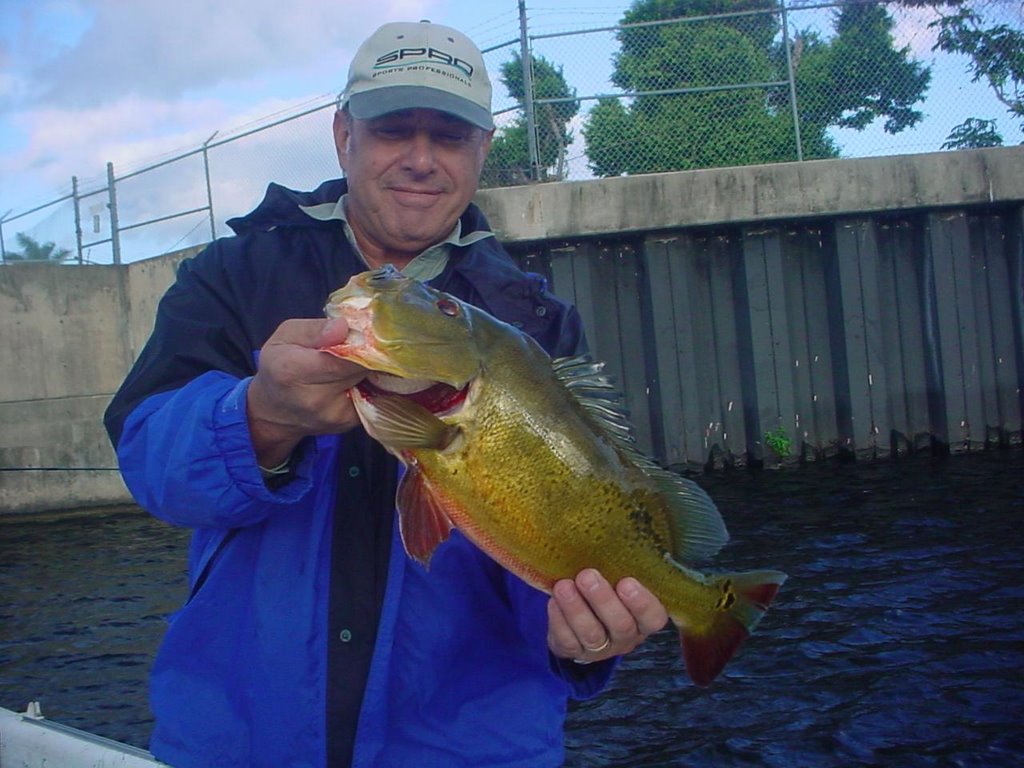
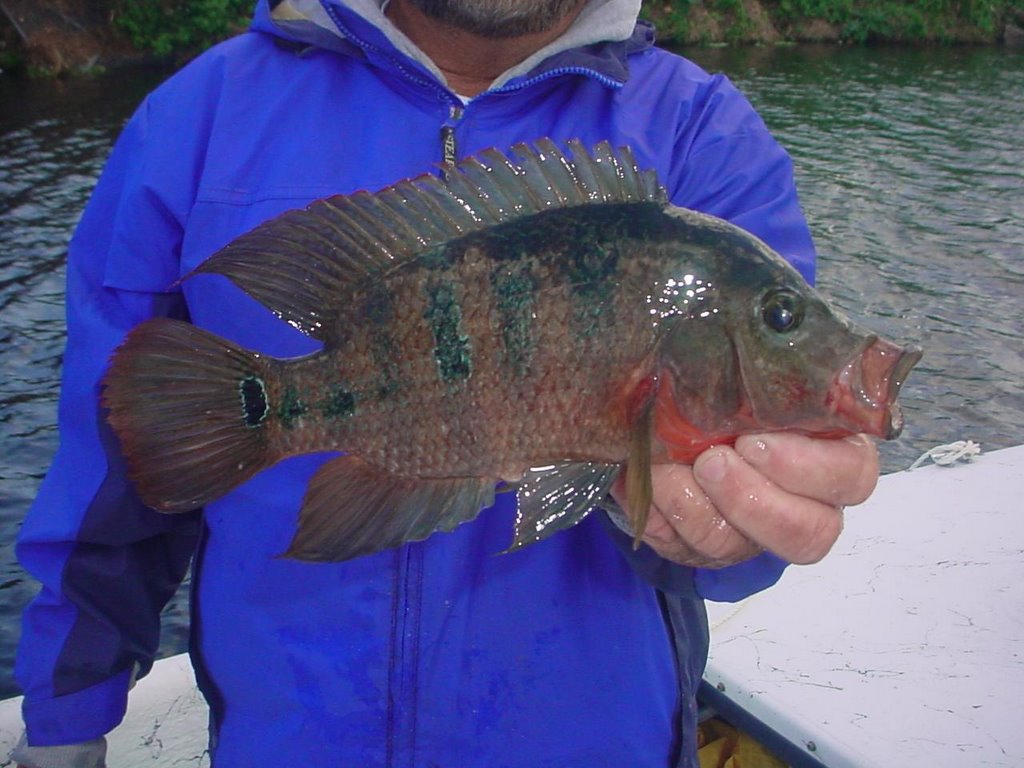
Captain Butch Moser does his magic by chumming with live bait: oftentimes threadfin shad. He also uses these delicate fish for live bait- and do they ever work! I'd wonder what a fly fisher could do with those big peacocks, largemouth, and Mayan cichlids as they're boiling at live chum barely a dab-cast from Butch's Carolina Skiff. Our catches ran to good sizes: peacocks to 6 pounds, bass to 8 pounds, and cichlids to 3 pounds. In a word, extraordinary, since the heaviest line we used was 6-pound test. I opted for 4-pound spinning and was thoroughly satisfied!

ABOUT CAPTAIN BUTCH-

Captain Butch proudly acknowledges a very long pedigree of fishing in various venues for over forty years since he was a child. He first started fishing as a hobby, but as he grew up, it became his life's work and labor of love. He has had stints as a charter boat captain for private clients as well as commercially hook and line fishing for kingfish, yellowtail, and grouper. About twenty years ago, it became clear to him that the fish stocks off the Boca/Delray Florida coast had declined. This trend made him turn his attention to fresh water fishing for largemouth bass and bluegills in the western canal system of Palm Beach County.

The factor that really turbocharged his freshwater guiding business was the stocking of this canal system with peacock bass. The "peacocks" flourished and created the makings of a "can't-miss" fishery that will delight any angler.

Butch has a specially designed Carolina Skiff that is an excellent and roomy workboat that is far more comfortable and stable than bass boats. The most striking feature of his rig is a massive livewell that's almost as large as a bathtub: this gives Butch the capacity to keep huge quantities of live bait that make his style of angling so incredibly productive.

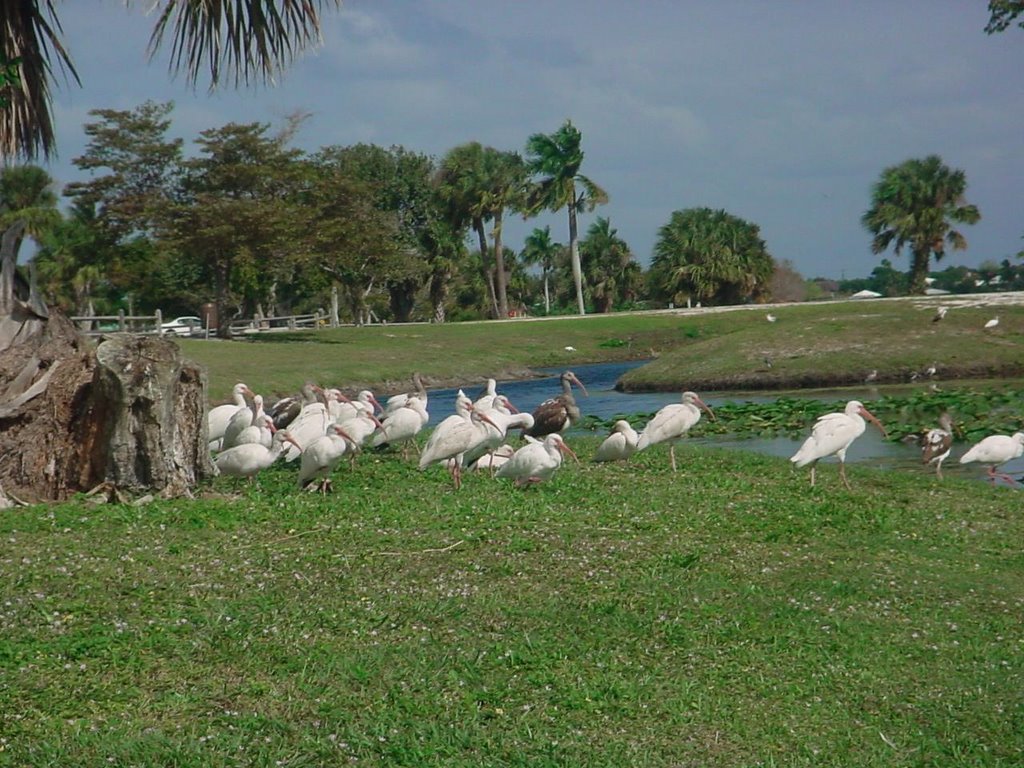
There was a wealth of wildlife that spiced up our foray into these canals: turtles, egrets, ibis, limpits, iguanas, and all manner of migratory ducks. We even caught a strange yet exotic fish that was called a clown knifefish.

I believe Butch Moser is a guide for all seasons from novices to experts. If you want to give your friends, family, or children an indelibly successful fishing trip, Butch's track record is likely to bring great results!


CONTACT DATA:
Captain Butch Moser
Cellphone: 1-561-254-2790
Home Phone: 1-561-732-5996


Jan

Sunday, January 07, 2007

Looking Forward to Belize River Lodge...

Though it might take awhile-like most things- photographer Art Blank and I can't wait to get down to Belize River Lodge (www.belizeriverlodge.com). This destination has an incredible pedigree in origin, history, and customer good will as well as current high marks in service, lodgings, vessels, fishing, and eco-touring. With those qualities, BRL pulls anglers and travelers like a magnet into the exotic coast of Belize.

This destination is one of those rare places on our planet where a quadruple Grand Slam ( bonefish, tarpon, permit, snook) is a real possibility.

Jan

Sunday, December 31, 2006

Another new book announcement...


In addition to specializing in Florida flats fishing, another passion of mine has been traveling the world in search of light tackle fishing in exotic destinations. Oftentimes, I chronicle and review my angling experiences at lodges that represent the very best there is to offer in places like Sandy Point, Green Turtle Cay, The Marls, Andros, British Columbia, Key West, Sanibel, and Cozumel. Other times, I'd pick a great location and arrange angling with some of the best guides I could find: Puerta Vallarta, Little Torch Key, Ketchikan/Alaska and Antigua are typical examples of such instances.

I'd made up my mind that I'd compile these adventures in story form and share them with the world-traveling angling community in the hopes of making their efforts easier as well as more fruitful. I also included some pieces on techniques like advanced wading and microbraid line developments.

All of this data came together in another new book of mine called, " Fishing Tips, Tales, and Travels". This volume should become available by March 2007. It will first appear on my website www.flatsfishingonline.com and spread to Amazon.com, Barnes and Noble.com, and BooksaMillion.com as well as other established online booksellers as the distribution channels mature.

Be on the lookout for it!

Jan

Saturday, December 30, 2006

A Happy Book Announcement!

I'm very pleased to announce that my upcoming book, "Fishing Florida's Flats: A Guide To Bonefish, Tarpon, Permit and Much More" has been given the expected publication date of November 2007 by University Press of Florida( www.upf.com). I'm especially proud that some of Florida's flats finest have joined me to offer their technical, angling, and artistic gifts in the book. They include Captains Bill Curtis, Tom Rowland, Greg Poland, Bob "R.T." Trosett, Butch Constable, Mike Locklear, Jon Cooper, and John Kumiski. I'm honored that artist Vaughn Cochran and artist-writer Tim Borski have contributed. Scott Heywood of Angling Destinations as well as Ranger Boats and Heritage Kayaks have brought in some great images.

This is a project long in the making and it has the kind of thorough content that is sure to add to the knowledge base of all the skill levels and specialties of shallow water anglers that fish- or will fish- Florida's beautiful flats.

Although the book is not physically ready, it can be ordered at any time. The easiest way to find the web page is to go to www.upf.com and type in Jan Stephen Maizler in the Search for Books by author box.

Jan

As the year ends...

Life in SOFLA. and its "capital" Miami (America's Casablanca or Babylon-take your pick) is even crazier as the region poises and poses for the advent of 2007. Shoppers and celebrants glut Lincoln Road and Aventura Mall: they swirl, climb, engulf and consume like locusts ruled by the Dark Force. Cold fronts attempting winter have reached the tip of our peninsula only to be engulfed in the sultry heat of a globally-warmed world.

Father Time leans over to pick up his fallen fly rod only to get butt-kicked into history by a fresh-born blonde brat wearing a Columbia diaper that sports "2007" on its stern. Joining Father on his way to the spinning hypnosis-wheel vortex are Saddam (resplendent but crooked in his hemp necktie), James Brown (with a brand-new bag), and Gerry Ford (pan lower, please... he's fallen!).

Refuge with purity exists on a more timeless and eventless basis for those obsessed with fishing: things like the immutable rises and falls of tides and changing moons, winds, as well as light and dark grab us out of the world of people and their quirks. Despite the changing faces and associations that life has dealt me, angling has given me something so powerful and unchanging, I'd even call fishing Religion!

Jan

Monday, December 25, 2006

1963...Then and Now


Something I recall like yesterday was my senior year in high school. A parade of exciting, triumphing, and promising images, events, and incidents begin their march down the main street of my mind. Though I had the academics easily "knocked", my focus was on far more important things: beautiful girls, a burgeoning taste for my father's Jack Daniels Black Label, and most importantly, lots and lots of fishing.

The priority of the last item became strikingly clear when I made my Prom date from the night before wait in my midnight blue Grand Prix as I fished dawn's light for snook around the docks of Biscayne Point. I released a 15-pounder in short order- it was caught on a Pfleuger Supreme plug reel, custom rod, and rainbow-colored Zara Spook plug. As I returned to the car, the sweet fishy odor on my hands followed me into the parlor of my vehicle already scented by Canoe, Jack Black, and primordial passion. I'm not sure I've changed all that much as to what I consider really important.

This was also a year of heroes for me- especially the Fallen Angel, Good but Bad types. My religion was Doo Wop, Rock and Roll, and Soul, Soul, Soul. A gas station became the place where I would meet my Burning Bush. Prior to biking to Sunny Isles Pier for the mackeral run, I'd stopped for my roady predawn breakfast of peanut butter crackers and ice-cold coke. As I finished, a huge black limo pulled up to the gas pump island and stopped. One of the rear doors swung open and out came James Brown himself. He was all gassed-up with a light blue tuxedo and perfect pomp atop jet black conked-back hair. As the Godfather passed by, he turned to me and said, "hello, son." I felt like I'd been blessed.

This morning I learned that James Brown died. Since I've always believed that James is the Molar Tooth of Soul, the ache of his loss is a hell of a pain. And James, I'll say to you as you sang so many times before... " Baby, please don't go- I love you so."

Jan

Friday, December 22, 2006

A Fine Day...

My good friend, Captain Jon Cooper, and I picked it right as we ventured into South Biscayne Bay today. The last week of fierce onshore winds died down enough to make a soiree on my sixteen-foot Hewes Bonefisher quite doable.

Jon and I had superb nonstop action on ladyfish to three pounds along with a few fat seatrout: the large live shrimp of November were just the ticket! As we drifted along, I hooked a tarpon weighing around sixty pounds. Although my only leader was a double line, I was able to get the fish on the leader after thirty minutes. The silver king fought spectacularly with an initial series of about a dozen greyhounding leaps.

After that, we ran to the flats for our remaining hour of fishing. The skies were cloudy and the winds were gusting to twenty knots. When we got a dark cloud behind our chum, visibility picked up. I spotted one large bonefish bolt in, then out of the chum. Ten minutes later, I hooked and released a ten-pound bonnethead shark.

Then, time to go in for chores and such- all in all, a fine day!

Jan

Sunday, December 17, 2006

Remote Rendezvous


Remote Rendezvous

AS FEATURED IN THE SPRING 04 ISSUE OF SOUTH FLORIDA SPORT FISHING MAGAZINE

by Jan S. Maizler
The Ultimate Mothership Adventure

The captain gently eased off the two throttles of the vessel Outpost. It coasted slowly to a silky stop over the crystal clear waters of the Great Bahama Bank. Gentle wavelets lapped against her shiny white hull. Far aloft of the Outpost, a lone seabird flew a long, lazy circle in the deep blue sky.The angler-passengers, guides, and crew onboard were flushed with excitement and anticipation as they waited for the “drop anchor” signal to be given.

Their fervor was understandable — not far in the distance lay the “Horn” of Andros Island’s fabled West Side. The Outpost got its passengers from Red Bays to the Horn in only three hours, briskly yet comfortably. The group had now arrived at their first delicious destination. The time of the cruise en route was filled with dreams of a bonefish, tarpon, and permit bounty that these virgin waters should yield. Clearly, the visions of explorers!

The five anglers and their two Bahamian guides, Stanford and Percy, had another goal besides fishing these new flats and shallows. This was to learn, document, and possibly map out new West Andros hotspots, a bit like Columbus. The prospect for the entire party was electrifying!The anchor was carefully dropped and more line was played out to ensure a good anchor set.

Head guide Stanford Johnson smiled as he gazed at the green mangrove shoreline.For him, this was a return to the home waters of his youth. Recollections of his deep past filled his head — a childhood in the small settlement of Red Bays, with the West side sea at his feet, and planted vegetable gardens inland to feed his village.As he became a teenager, he learned of a growing need of sponges in the markets of Europe. He knew that there were treasure troves of sponges far to the south, deep into the wild West Side. He set forth, and explored as he went, learning the shorelines as he harvested his sponges.Stanford would venture deep into the creeks to catch snappers and crabs for his meals. If he went deeper into the Andros interior, he would eventually find good, drinkable, “sweet water.”

Practically every shoreline and creek was filled with bonefish, and he learned their habits as he worked.When his boat was filled to the brim with sponges, he would travel far north to his village, where a hot meal of conch and vegetables was inevitably waiting. Then, the sponges would have to be pounded into their smooth, familiar pliability; hard work for anyone.These trips not only forged Stanford’s growth into manhood — they also created West Andros’ premier flats guide!

A friendly tap on his shoulder from Scott Heywood pulled him back into real time. Scott told him that both skiffs were being readied. In went the ice chests filled with food and plenty of water. Each skiff was then loaded with a full complement of fly rods and every conceivable “killer” fly. Each boat was then topped off with three anglers and their guide.Stanford would man the lead skiff. Both four stroke engines fired up quickly and quietly, and off they flew towards the Horn of west Andros to make mothership history.

The next seven days of fishing and exploration brought weather both fair and foul, calm and windy, yet the intricacy of the West Andros shorelines and creeks offered features to make fishing possible in almost any conditions.Under the guidance of Stanford and Percy, Scott and his party caught and released tailing bonefish, mudding bonefish, cruising bonefish; fish both large and small, and in every possible way. As a bonus, a nice permit was caught and released.As the West Andros leg of the mothership journey came to an end that evening, the entire group agreed that the week was a resounding success!

The afterglow and joy of fishing The Horn slowly gave way to the excitement of what their next Bahamian destination would offer.The background and operation of the Bahamian mothership Outpost is quite interesting. Scott Heywood and Brad Wolfe at Angling Destinations (www.anglindestinations.com; 1-800-211-8530) had, and still enjoy tremendous success putting their client-anglers on traveling motherships in Belize and in the faraway, exotic Seychelles. What they needed was a vessel to explore and fish the most remote and least-pressured parts of the Bahamas.

It was a stroke of good fortune that Scott and Brad were contacted by Captain Fred and Penny Wheeler, who had been running the Outpost in the Key West-Marquesas area.What they found with the Outpost was a vessel that exceeded all the necessary requirements for a Bahamas mothership. Long and spacious as a 61 foot Hatteras yacht, she sported two powerful Isuzu “workhorse” engines. Her hull type was of a shoal draft vessel, an absolute necessity for cruising across the shallow Bahamas Banks. Her reverse osmosis water production plant provided lots of fresh water that would easily meet all daily needs. The Outpost’s air conditioning was so efficient that the guests “hollered uncle” as the temperature plummeted to 68 degrees. Full communications systems were onboard for any and all contingencies. In addition, a satellite T.V. entertained all on onboard, as well as keeping everyone informed.The fishing skiffs and other auxiliary vessels that accompany the Outpost met all needs. There are two flats boats outfitted with quiet four stroke engines, trim tabs and modern pushpoles. There is a flat-bottomed Carolina Skiff for snorkellers and scuba divers. Topping off the vessel selection are kayaks for exploratory eco-tours, or just plain fun.Scott also reported to me that the Outpost can take as many as six passenger-anglers, who can look forward not only to the excellent lodgings, but to delicious meals as well.

I asked Scott to elaborate about Angling Destinations’ commitment to motherships. He responded, “we’re sold completely on the mothership concept.” “It provides so many desirable characteristics. The first, of course, is the freedom to establish a base of operations where there are no existing or desirable facilities — often the case in unpressured, virgin waters. The second is that the mothership provides portability that drastically reduces the length of fishing boat runs to and from the fishing grounds.” The third factor he emphasized was the immense control and consistency in food, lodgings, and clients that chartering a mothership affords.

This intimate experience creates significant interaction between guests, guides, and crew, and Angling Destinations either books groups of pre-existing friends or carefully composes a group of individuals they know quite well. This creates friendships and fellowships that far outlast this exciting voyage!The mothership experience not only creates friendship bonds; it also creates family bonding.

The Outpost is perfect for the needs of any average family, because it has the diversity of features that will please every member: “unlimited” fishing for dad, loads of indoor pleasures for mom, and kayaks and snorkeling for the kids. Each family can begin and end their days together at the galley table, and spend time eating great food and sharing their exciting experiences. Come nightfall, the family can go on deck and enjoy intensely starry heavens unmarred by the bright lights of cities. You can be sure the Outpost will be comfortably moored in the lee of an island, yet far from any bugs, or she’ll be underway to a new destination.Scott feels so enthusiastic about using the mothership for enhanced family experiences.

He said, “the main goal of Angling Destinations is for our clients to enjoy themselves and have fun.”Scott went on to relate an extremely moving story that will soon involve the mothership Outpost. He was recently contacted by the sons and daughters of an aging father whose time “was short.” They said to Scott, “we want to give him the dream trip of a lifetime.” Much like a master chef, Scott prepared an experience on the Outpost for this man and his family sure to leave stardust memories.So, the Outpost literally becomes a family’s private traveling hotel or cruise ship, where the dream of a distant Bahamian island is yours for the asking!

The Outpost also has distinct advantages over land-based camps in the Bahamas. The Outpost’s portability can immediately respond and change cruise plans to avoid severe weather, while a land-based lodge must grin and bear it. The Itinerary can also be immediately modified because of any personal urgency or emergency. Compare this to a land-based camp that often must juggle your needs with ten other anglers — you rightfully begin to get the idea that the mothership is ideal for those needing a high level of personal control and personal freedom.

In small measure, I could appreciate their pioneering efforts, having experienced some great fishing in Mexico, Tahiti, Fanning Island, and Belize. Scott and Brad have created the ultimate freedom where anglers transcend themselves. The Outpost provides such a special and unique opportunity for growth and exploration because of the intimacy of the voyage and the frontier virginity of the areas it visits.

The next chartered destination offered a new group of angler-guests another piece of the “Holy Grail” of Bahamas flats fishing — the fabled Marls of Abaco. The Outpost would arrive at its mooring area west of the Marls and north of Moores Island in a few hours. The Outpost’s positioning strategy was designed to fish the least - visited flats — not only would this offer the most productive flats fishing, it would also coordinate angling efforts not to overlap areas reached and fished by the land-based guides.Abaco, so different from Andros, is more like a fertile, magic crescent. The larger outside of the arc to the north, east, and south of the island offered the sapphire deeps that lured so many bluewater anglers in their huge fifty foot vessels.

Yet, it was the inside of Abaco’s crescent on its west side that pulled on the Outposts’ anglers like a fishy magnet. The Marls of Abaco was calling them! The draw for everyone aboard was to explore the almost infinite number of islands and cays that comprise the area. The anglers knew they would be fishing the epicenter of Abaco’s flats nursery that would offer huge quantities of bonefish.Soon, the Outpost would again drop anchor. Then, starry-eyed anglers and their hawk-eyed guides would man the shallow draft skiffs. Trusty engines would fire up quickly. As the guides pushed their throttles forward, they were also pushing their angler-clients towards shallow water habitat that may have never seen a boat or even a person.

It will be a rare and wonderful opportunity to fish truly new and virgin waters. It will be even more wonderful to do this on flats where the encounter with truly brand-new fish is from sighting to cast, battle, and release. There may very well be seas of silvery bonefish tails grazing over sandy flats only a short distance away. You squat down and slowly begin the Walk of all Walks. You have to contain your excitement. You ease forward like a wading bird, striving for not even the slightest pressure wave. After a million heartbeats, you’re in range for a cast. Breathing deep to steady yourself, you make your presentation perfectly. A dozen fish quickly converge on your fly, and tail up all over it. You strip-strike to a hookup that dumps yards of line off your reel in seconds. Tight lines over white sands under blue skies. You’re in Paradise in another day of life for the Outpost!

Jan Maizler

Saturday, December 16, 2006

Rainy Days...

I've always opted for summer as the model for weather predictability. Wintertime in SOFLA. often means working the weather between fronts for fishable times, yet the severity of the just-past front as well as its duration can feature cool dirty water under sunny warming skies. Add the prefrontal lip of a front and you might add a few more days of rainy, cloudy weather-like we're having now.

This is a time for me to work on the boat and the tackle, as well as picking up backburnered projects for completion. One of these is development of a top secret fishery on a South Pacific island. This suits me just fine.

Jan

Monday, December 11, 2006

Back from the Cheeca...


Although a front which blew like a freight train kept me and Captain Greg Poland off the water this weekend, it did nothing to diminish four thoroughly satisfying days at the Cheeca Lodge (www.cheeca.com). This destination- which had its roots as THE PLACE for the fishing elite- has truly come of age as the ultimate full service resort for travelers to the Florida Keys. I and Florida Sport Fishing Magazine (www.southfloridasportfishing.com ) look forward to telling The Cheeca story.

With the windfall (because it didn't) of extra time on land, my explorations turned up two more jewels which sit on the Purple Islands. One was The Stacie Krupa Gallery(305-517-2631). I spoke with Stacie, who is a Mighty Aphrodite of a woman and a multi media artist steeped in a knowledge of art history. Once I mentioned Oscar Kokoschka, we were off and running. Her work is bold, striking, and often technically perfect.

The other jewel was the impeccable Pierre's at Morada Bay (www.pierres.restaurant.com). I cannot recall such superb food and beverage on the shores of Florida Bay before. Their wine selection, food presentations, and marvelous decor make this a must-visit destination for those that appreciate fine dining.

Jan

Friday, December 01, 2006

Bluff House - Green Turtle Cay - Abaco- Bahamas...


Florida Sport Fishing Magazine

DESTINATION FISH: This is no bluff!

AS SEEN IN THE MAY/JUNE 2006 ISSUE By Jan Stephen Maizler

Even though I have always felt that the Abacos offer a rainbow of fishing venues, my recent experience at Green Turtle Cay delivered the proverbial light tackle pot of gold. In retrospect, I cannot recall such large numbers of trophy-sized Bahamian bonefish per square mile in addition to so many strong, hungry reef gamesters tucked into such shallow water.The reasons for this bounty are clear. While Green Turtle Cay is separated from the northeast Abaco mainland by close to two miles of bay, the northeast side of this island features a barrier reef, and then a steep drop into a near abyssal pond called the Atlantic Ocean- where all sorts of fish grow big!

The comparatively small size of Green Turtle Cay and its oceanic position, coupled with the nearby cuts in the reef, allow larger gamesters to approach the island along its eastern shores and work their way west into the bay. But let’s scroll back to the beginning of this adventure, which had its own special brand of excitement.

The planning for my trip and my destination of Bluff House Beach Hotel and fishing with the area’s top flats and light tackle guide, Captain Rick Sawyer, was carefully set in October. This month was supposedly a time of year when hurricanes are on the wane and winter fronts belong to the future. However, a late season storm by the name of Wilma changed all of that. South Florida took a severe beating, as did the northernmost Bahamas. Finally, a month after my original plan called for, I was on a flight from Fort Lauderdale to Treasure Cay, which is on the Abaco mainland, only a couple of miles inshore of Green Turtle.

November brought inevitable changes in climate that ushers in winter to this region. As the plane touched down on the Treasure Cay runway, it was easy to feel the powerful winds of a recently passed front. I grabbed a quick taxi ride to the ferry that would shuttle me across the bay to Green Turtle. As I boarded the vessel with my luggage and rod tube, the cool brisk winds were now joined by a substantial shower, yet the vessel’s ample cabin kept all the passengers snug and dry. The passage to the White Sound area of Green Turtle Cay featured stiff 20 mph winds that created little whitecaps that were barely visible in the waning light. As we got into the lee of the Sound, the wavelets were replaced by the constant splashes of huge schools of balao being savaged by aggressive schools of tarpon. The kings fed with abandon; one forty-pound fish exploded within a few feet of our ferry vessel as it pursued a tasty baitfish. The white water that accompanied its strike gave off a luminous flash that quickly subsided in the darkness.

All these conditions gave me a magic kind of introduction to the Bluff House. The ferry had radioed Bluff House of my arrival, so an attendant with raincoat and a covered golf cart eased my transfer into the resort. My evening registration was accomplished at Bluff House’s Jolly Roger Bar & Bistro. A few quick formalities were followed by friendly welcomes by staff while a colorful libation called a Tranquil Turtle started my evening’s refreshments. I settled into a comfortable waterfront table and dined on a late, first-rate supper of conch, lobster, steak, and Key lime pie.

When my meal was at an end, a staff member drove me to the top of the hill where my room stood. The interior was huge and was set off with luxurious Caribbean appointments. However, the most striking element of this grand room was its exquisite balcony view which overlooked the ocean below.

After settling in, I gave my Green Turtle guide, Captain Rick Sawyer, a call. When we discussed the weather, he said we were in a “squeeze play” between a departing front and an approaching low-pressure system. He said that unless the conditions worsened, we’d be able to fish the next day and would hopefully be able to find some decent action. Those reassuring words, plus my striking nighttime entrance to the island, made deep sleep easy to attain.

Morning came quickly. After preparation, I left my room atop the bluff. As I strolled down the hill towards the Jolly Roger for breakfast, I watched an early morning unfolding which featured a brisk northeast wind under a partly cloudy sky. A hearty breakfast was satisfying and temporarily took away my weather doubts. As I was finishing the last few drops of coffee, I noticed Captain Rick approaching the dock adjacent to my waterfront table. I was pleased to see that his flats fishing rig was a 17 ft. Maverick paired with a 90 horsepower Yamaha four-stroke. The rig looked quite capable of easily handling rough open waters.

As we eased out of White Sound Harbor, we began to lay out our battle plans. It was good that we’d chosen a lunar period that featured neap tides, since the now-rising tide turbocharged by the strong onshore winds made the ocean flats quite deep. Rick said we’d fish the lee sides and western flats of Green Turtle and the cay’s adjoining keys. Our specific poling strategy was to work the sandy strips alongside the pine tree-lined shoreline where visibility would be at its best.In contrast to my own two-stroke engine, Rick’s four-stroke remained quiet when he advanced the throttle.

As we came on plane, he turned his skiff northward and hugged the rocky slopes of the island for wind protection. We crossed a windy cut quite comfortably, and Rick slid his skiff into a winding creek that eventually led to calm water. Around the bend, I could make out another white-capped ocean inlet.As Rick climbed to the poling tower, he encouraged me to use a fresh shrimp with 10lb. spin tackle. He felt spinning gear offered the best cast control during such adverse conditions. The large shrimp would be fine since the wind-riffled surface would muffle the landing of the big bait. As we began to work the sandy shoreline, we spotted a hefty mutton snapper of about 15 pounds roll up along a nearby edge, but the colorful fish quickly bolted at the sight of our skiff. However, this was a good sign that fish were feeding on the flats. Within another minute of poling, Rick spotted a shadow in the distance and instructed me to cast the bait to the two o’clock position within six feet of the shoreline. I quickly complied with an accurate cast, and as the bait settled to the bottom in about twelve inches of water, I too saw the large silhouette ease up to the presentation. It felt like my heart stopped beating as I stood motionless in anticipation. My bait disappeared and instantly my line tightened. I quickly jab-struck the fish a few times for good measure. The line flew off the reel, and I knew I was into a healthy bonefish. In about five minutes, we released a very respectable seven to eight pound bone.

We poled for another half hour without seeing too much. As we rounded another bend, Rick and I both spotted a good-sized ocean tally of about ten pounds tailing forty feet from us next to the shoreline. I simply couldn’t resist, as this is not a typical fish in my home waters of Biscayne Bay. I had an instant take and struck the fish. Much like its predecessor, it gave an excellent fight. As I brought the exhausted battler to the boat, Rick climbed out to unhook and revive the tally before releasing her back into the tropical water. As he climbed back to the poling platform, Rick called my attention to a huge squall line headed our way. Wisely, he felt we should head back to port rather than suffer through this huge gray monster. It was a wise move, since the storm generated gale force winds and torrential rain that blotted out any safe fishing chances for the remainder of the afternoon. Rick and I mapped our contingency plans for the next day as we listened to weather reports back on the island.

Day Two- Hopes of a better day were realized when dawn revealed vastly diminished winds and a greater percentage of blue skies. We left early to maximize the fishing hours I had left. With the high water and low sun, Captain Rick could not resist the opportunity to take me to one of his favorite sunken wrecks. He had no problem finding the site with his handheld GPS and the obvious showering balao. In the few hours we waited for the falling tide, I quickly lost count of the large cero mackerel, big yellowtails, and fat mutton snapper I released using nothing more than an 8lb. spinning rig topped off with a short length of fluorocarbon leader. A white Spro bucktail sweetened with a fresh balao strip was all that was necessary.

As the tide finally began to fall, it was time to head back to the ultra-clear shallows. We quickly ran to a flat on the south side of the island. As we ran the drop-off, we flew over a school of about a hundred bonefish, all of them truly huge. Though the winds were picking up again, Captain Rick ably turned his skiff in pursuit and poled down the flat. We spotted a large mud about fifty feet away, and I made a good cast to the freshest part. In a replay of the day before, my line tightened up and I struck the fish. This was a longer fight, which resulted in the capture and release of a trophy ten-pound bonefish. Though we saw more bonefish on that flat, and all of them were quite large, a freshening wind and time constraints forced us to call it a day. All in all, I had an excellent experience with Captain Rick Sawyer, who expertly guided me in a habitat that may very well be home to the largest bonefish per square mile than any other destination in the Bahamas!

Bluff House Beach Hotel- Bluff House, as I call it, is one of the most beautiful island destinations in the world. Its noble Loyalist past helps create a historically based, Caribbean-motif resort that sits along the slopes atop one of the rare hills not just in the Abacos, but in all of the Bahamas. All the deluxe rooms and suites feature striking ocean views.The activities at Bluff House center around some of the finest fishing, boating, beaching, yachting, trekking, and exploring in the world. Do as little or as much as you want!

Bluff House has been consistent with their Atlantic hideaway philosophy: there are no televisions or phones in the rooms. However, there is a television in the lounge of the Clubhouse. There are also televisions with tapes and videos for rent. In the event of necessary communications, there are fax, internet, and phone services available in the main office.*Breakfast, lunch, and dinner are served waterside at the Jolly Roger Bar and Bistro. Other special events can be handled at the Clubhouse atop the hill.* Bluff House features a delightful fresh water pool and newly refurbished tennis court. There are two gift shops at Bluff House. Aladdin’s Cave is located in the main office and The Low Tide Gift Shop is located next to the Jolly Roger* Bluff House offers a total range of top guides, services, and rentals for every conceivable fishing, boating, diving, and beach activity.*Golf cart rentals are available so you can explore the entirety of this magnificent island on your own.

WHEN YOU GO-
Bluff House Beach Hotel,
Green Turtle CayAbaco, Bahamas
1-800-745-4911
www.BluffHouse.com

Captain Rick Sawyer
Green Turtle CayAbaco, Bahamas
1-242-365-4261
www.AbacoFlyFish.com

TRANSPORTATION- You can fly direct from Fort Lauderdale on Continental/Gulfstream to Treasure Cay, Abaco. Take a five- minute taxi ride from the airport to the Ferry Dock. The ferry, which runs every hour, will whisk you to Green Turtle Cay for $10.00 per person. Tell the pilot you’re going to Bluff House and they’ll have someone waiting as you get off right at the Bluff House Dock.NEW PLYMOUTH- Be sure to rent a golf cart and visit New Plymouth, which is the main town of Green Turtle Cay. Located on the southwest side of the island, it is one of the oldest townships in the Bahamas. Plan on visiting the Albert Lowe Museum, Vert’s Model Ships, The Loyalists’ Sculpture Garden, The Historic Jail, and the fine local restaurants and shops.

Jan Maizler for
Florida Sport Fishing Magazine

Back at Biscayne Bay...

Windy weather is prevailing out of the southeast at 20 knots- this did not make the tarpon happy. In contrast, silver kings like the gusty stuff at nights to push crunchy snacks like crabs towards bridge pilings. But in the rising sun and open water situations, not so. I saw a few roll quickly- not the slow tipping or slurping rolls I like to see. I did catch a small king mackeral of 4 lbs. and a large gray snapper of 3 lbs., both of which made it pleasant. As I worked a seawall, 2 large jacks pushing 20 lbs. blasted one of the remaining finger mullet of a tepid fall run. I flipped a TerrorEyz into the melee, but the bullies wanted real meat.

Jan

Monday, November 27, 2006

Looking Back Over the Year...

It's time to say "thanks" to some fantastic people and incredible destinations that have made it a banner year for this writer.

* Captain Tadd Van Der Mark and Ranger Boats- Florida Bay, Florida
* Buck Buchenroth and Southern Cross Club- Little Cayman Island, BWI
* Captain Samuel Knowles and Samuel Knowles Bonefish Adventures- Long Island, Bahamas
* Captain Brian Hillier and Naden Lodge- Queen Charlotte Islands, British Columbia
* Captain Clint Goyette, Valley Fishing Guide Service- Whistler, British Columbia
* The Space Coast Office of Tourism- Melbourne, Cocoa, Titusville, Florida
* Captain Brian Pahmeier and East Cape Canoe Boats- Titusville, Florida
* Saint Johns Tourist Authority- Saint Johns, New Brunswick
* Destination Halifax (Deanna Wilmshurst)- Halifax, Nova Scotia
* FloridaPeacocks.com and Captain Alan Zaremba-Miami. Florida
* Bobby Settles and Casa Blanca Lodge- Ascension Bay, Quintana Roo, Mexico
* Cheeca Lodge- Islamorada, Florida Keys, Florida

Jan